Tokyo University of Agriculture and Technology Tanaka & Kataoka Lab.
Blue Transformation
In recent years, there has been a growing need for a material recycling-based manufacturing and energy strategy to address global challenges related to energy, resources, and food. This strategy focuses on the recovery, recycling, and utilization of untapped resources. Our laboratory is promoting educational research aimed at building a foundation for efficient and sustainable resource circulation in both marine and terrestrial areas (https://bxgx.tuat.ac.jp/).
Material Circulation in Marine Environments
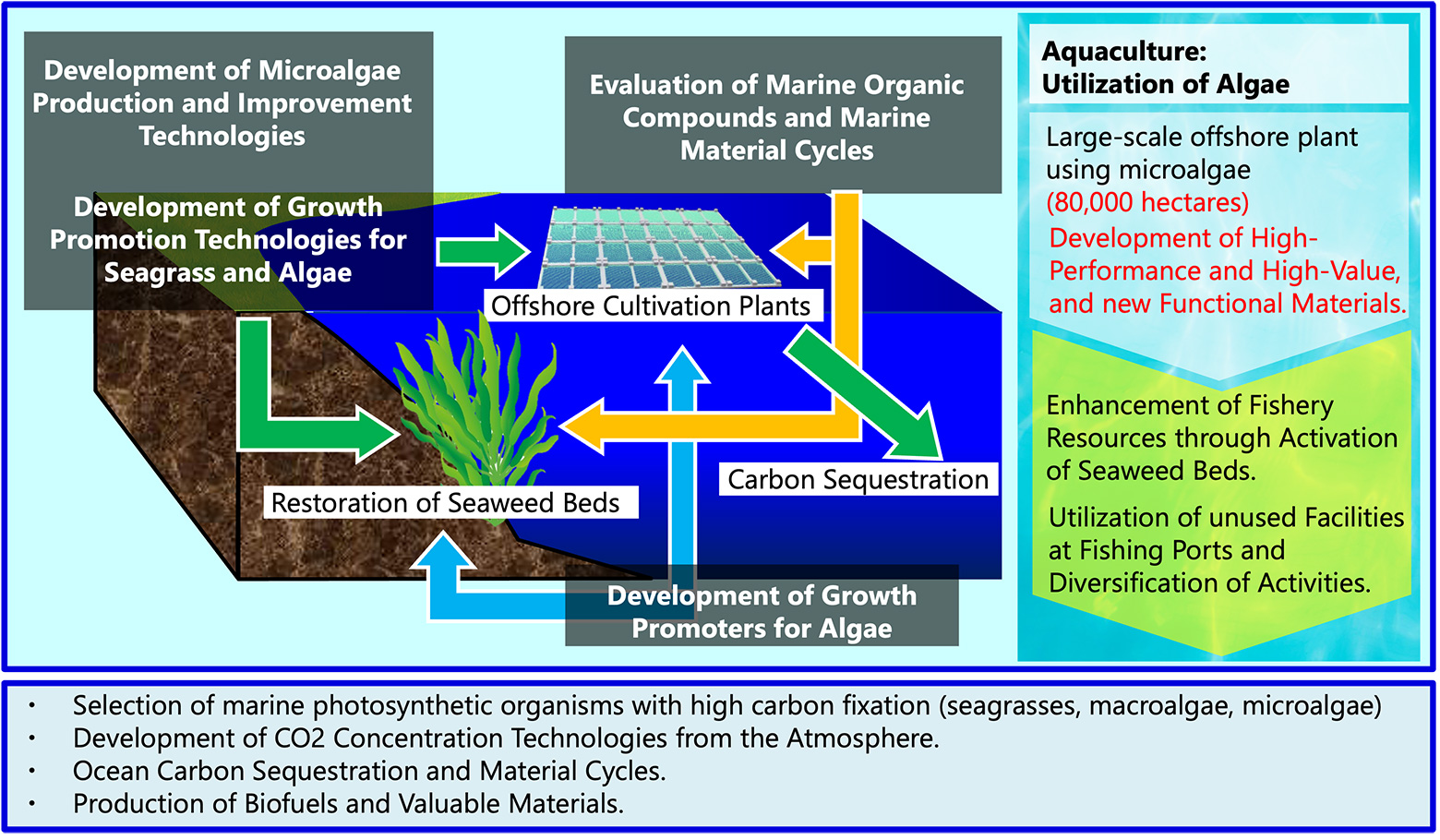
To achieve carbon neutrality by 2050 and reach net-zero greenhouse gas emissions, it is essential not only to reduce CO2 emissions but also to develop negative emissions technologies for CO2 absorption. We are focusing on blue carbon as a new source of CO2 absorption. Blue carbon refers to the carbon absorbed and stored in marine ecosystems such as marine algae, seagrass, wetlands, tidal flats and mangrove forests. We are developing carbon sequestration technologies for marine environments aimed at negative emissions, while also pursuing material recycling-based manufacturing (Blue Transformation) that utilizes blue carbon.
Our laboratory is particularly focused on marine microalgae, which have more than ten times the carbon fixation rate (absorption rate) compared to land plants. This makes them a promising candidate for applications in carbon sequestration in the ocean. We are conducting research aimed at establishing highly efficient carbon sequestration technologies using marine microalgae. Additionally, to realize carbon recycling through blue carbon, we are advancing multi-omics analysis of marine microalgae and developing genetic modification and genome editing techniques(Fig. 6). (https://www.jst.go.jp/pf/platform/)
Material Circulation in Terrestrial Environments
In response to global challenges such as population growth, climate change, weather-related disasters and changing diets, there is an urgent need to develop a sustainable agricultural production system that can adapt to changes in both the natural environment and food consumption patterns. We are working on the development of a nutrient cycling system for elements such as nitrogen and phosphorus, which are essential for future food sources like soybean production. By efficiently recovering nitrogen and phosphorus from wastewater and waste materials from human settlements and reusing them as agricultural microbial inputs for soybean cultivation, we aim to achieve resource-circulating food production. We are developing microbial materials that utilize soil microorganisms to promote nutrient cycling. These materials are expected to stabilize the supply of phosphorus, nitrogen, and other essential minerals to agricultural land and plants, reduce the use of chemical fertilizers, and enhance crop yield and disease resistance (https://www.microbe-soil.sci.waseda.ac.jp/).