Tokyo University of Agriculture and Technology Yoshino Lab.
Magnetosome Display Technology
Magnetic nanoparticles biosynthesized by magnetotactic bacteria
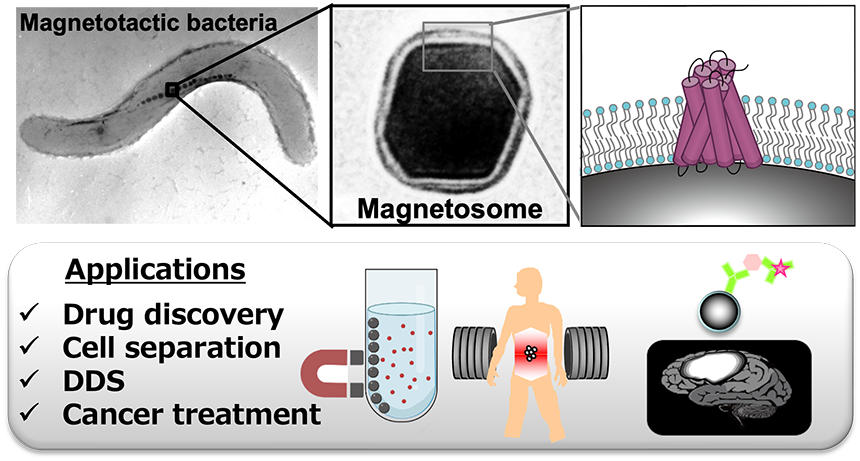
Magnetotactic bacteria are microorganisms capable of intracellularly synthesizing nanoscale magnetic particles called magnetosomes by incorporating iron ions from their environment. Magnetosomes are magnetite (Fe3O4) crystals enclosed in a lipid bilayer, characterized by their uniform size and morphology, high dispersibility in aqueous solutions, and excellent biocompatibility. These properties make magnetosomes superior to artificially produced nanomagnets. Consequently, magnetosomes have been applied in various fields, such as the development of highly sensitive immunoassays and their use as magnetic carriers in drug delivery systems.
Magnetosome display system
Magnetotactic bacteria can serve as host organisms for the production of foreign proteins through genetic recombination techniques, similar to Escherichia coli. A key advantage of using magnetotactic bacteria as hosts is their unique ability to display foreign proteins on the surface of magnetosomes.
Mms13, the most abundant protein on the magnetosome surface, acts as an “anchor molecule” for various foreign proteins. In our laboratory, we have developed a “magnetosome display system” by utilizing Mms13 to immobilize foreign proteins on the magnetosome surface. This innovative system enables precise functionalization of the magnetosome surface, allowing forthe creation of magnetosomes with customizable functionalities.
The successful development of this technology expands the potential for applications in fields such as biotechnology, diagnostics, and drug discovery. Tailored magnetosomes can be employed for targeted interactions, enhanced biomolecular stability, and the efficient production of functional protein-magnetosome complexes.
