Tokyo University of Agriculture and Technology Biomolecular Engineering & Marine Biotechnology Lab.
The phenomenon by which organisms form inorganic materials within their bodies is called biomineralization. In this process, organic molecules within living systems play crucial roles, forming precise inorganic structures under mild environmental conditions. Due to these excellent properties of biological systems, biomineralization has attracted attention as a next-generation inorganic material synthesis process with low environmental impact. Our laboratory uses magnetic particles (magnetosomes) composed of iron oxide biosynthesized by magnetotactic bacteria as a model to elucidate biomineralization mechanisms and develop innovative functional nanomaterials applying these biological mechanisms.
Magnetotactic Bacteria
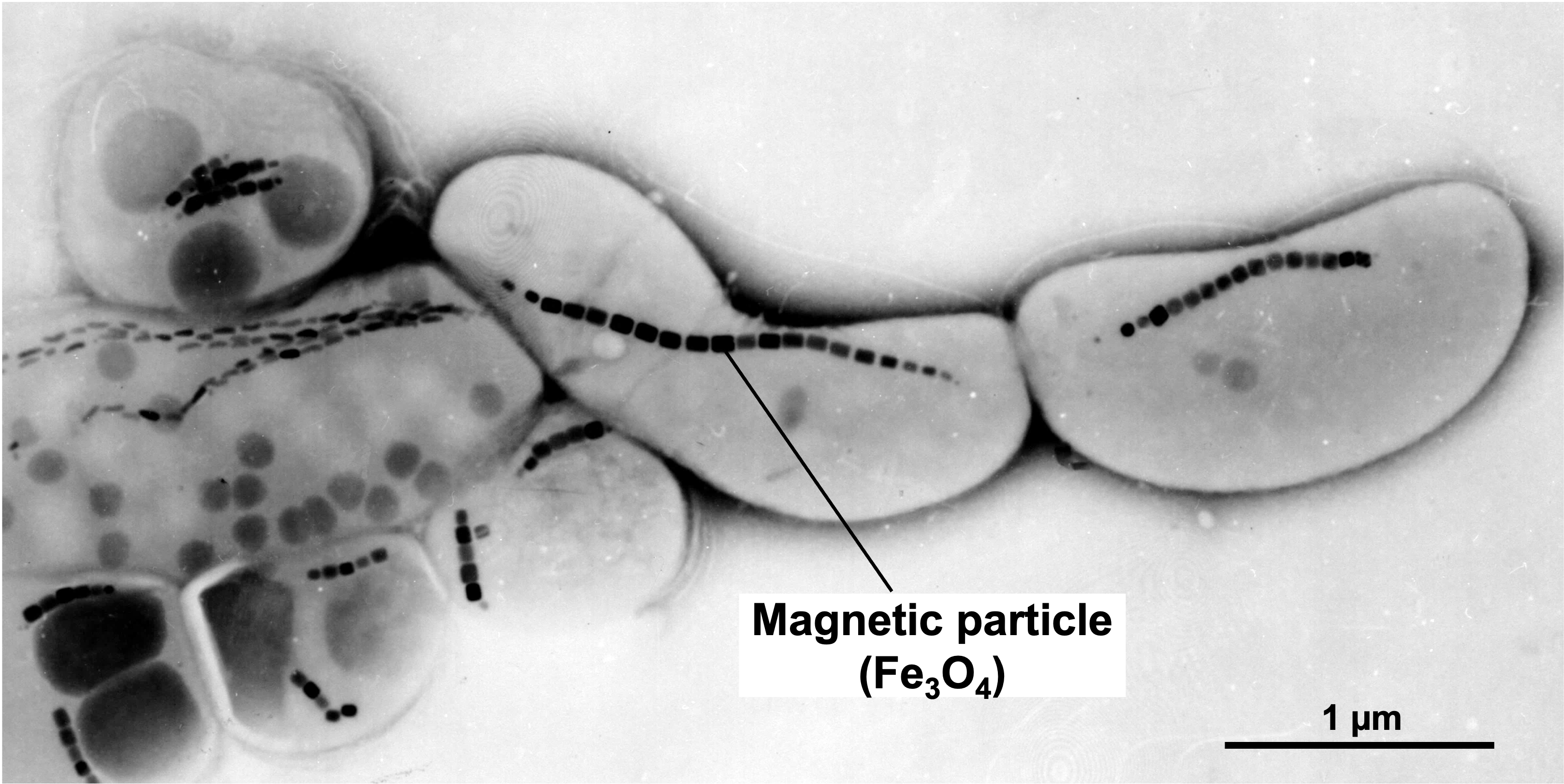
Magnetotactic bacteria are microorganisms that precisely synthesize magnetic particles within their cells (Fig. 1). Magnetotactic bacteria are anaerobic bacteria that utilize intracellular magnetic particles as biological compasses, exhibiting unique behavior called magnetotaxis by sensing Earth's magnetic field to swim toward sediment layers with low oxygen concentrations. They are distributed in aquatic environments worldwide and selectively uptake trace iron ions from the environment to synthesize magnetite (Fe₃O₄) magnetic particles with a diameter of approximately 40 nm. Depending on the bacterial species, complex and precise morphologies such as cubic, octahedral, and bullet-shaped forms are controlled, which are difficult to achieve through chemical synthesis methods.
Magnetic Particle Synthesis Mechanism
Our laboratory was the first in the world to decode the complete genome sequence of magnetotactic bacteria and elucidate the overall picture of the synthesis system through comprehensive analysis of gene clusters involved in magnetic particle synthesis (Fig. 2). The biosynthesis of magnetic particles proceeds through precisely controlled steps: formation of magnetosome membrane vesicles by invagination of the inner cell membrane, concentration of iron ions by transport systems, and crystallization of iron through alkalization of the pH environment. At each stage of this complex process, protein groups specific to magnetotactic bacteria cooperatively perform specialized roles including membrane vesicle formation, iron transport, pH regulation, and crystal growth control.

Morphological Control of Magnetic Particles
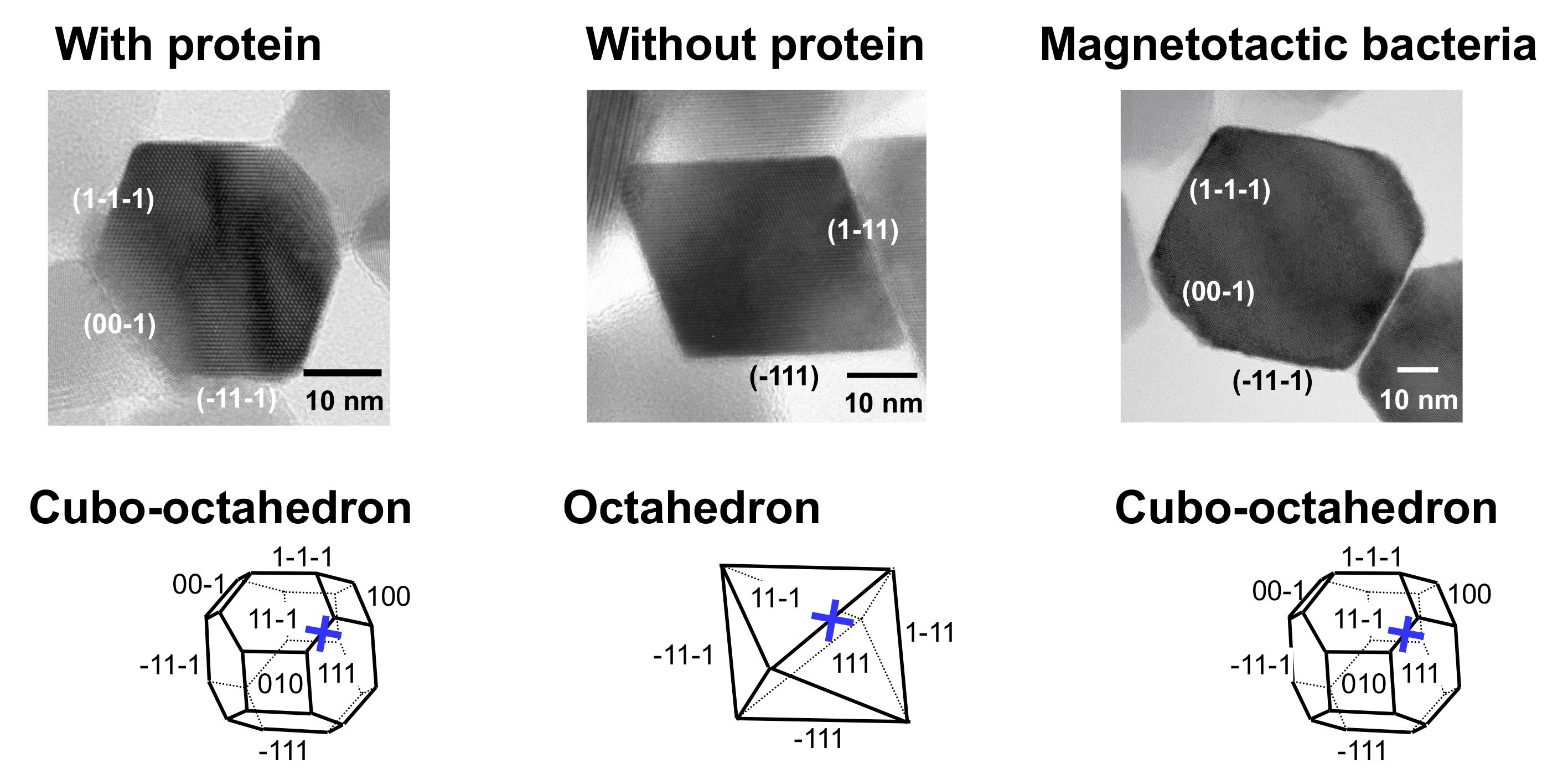
Magnetic particles are functional materials with wide-ranging applications from medical fields such as magnetic hyperthermia and MRI contrast agents to magnetic recording media. However, conventional chemical synthesis methods face challenges including difficulty in precise morphological control and high environmental impact. Our laboratory develops design and manufacturing technologies for magnetic particles tailored to specific applications by utilizing the biological control systems of magnetotactic bacteria. By incorporating morphology-controlling proteins isolated from magnetotactic bacteria into chemical synthesis, we achieved the first successful morphological control of magnetic particles using biomolecules (Fig. 3). This innovative biomimetic synthesis method is expected to enable the creation of magnetic materials with complex structures and superior magnetic properties impossible with conventional methods.
Magnetic Particle Production by Genetically Modified Magnetotactic Bacteria
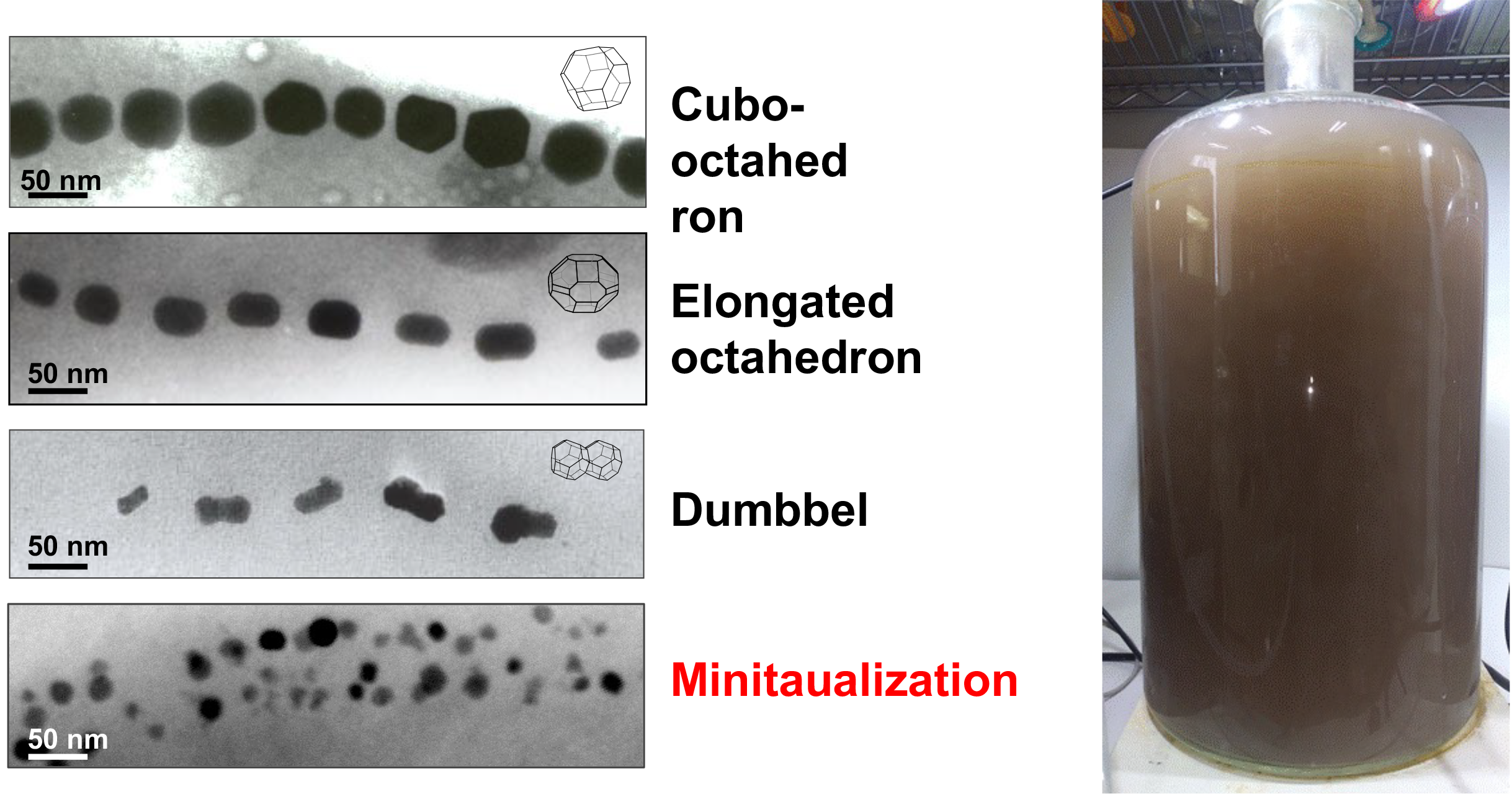
Through identification and functional elucidation of magnetic particle synthesis gene clusters, precise control of cellular magnetic particle synthesis capability became possible through genetic modification of magnetotactic bacteria. Through gene expression regulation and mutant strain construction, we have successfully controlled the synthesis of magnetic particles with diverse sizes and morphologies (truncated octahedron, elongated octahedron, bullet-shaped, dumbbell-shaped, etc.) (Fig. 4). We have also achieved production of magnetic particles with complex morphologies and anisotropy impossible through chemical synthesis. Furthermore, we have successfully increased magnetic particle content several-fold compared to wild-type strains, establishing the foundation for mass production technology toward practical applications. These technologies have enabled the creation of custom-designed magnetic particles.